
Just another Tube? ….Or the answer to scalable aquaculture?
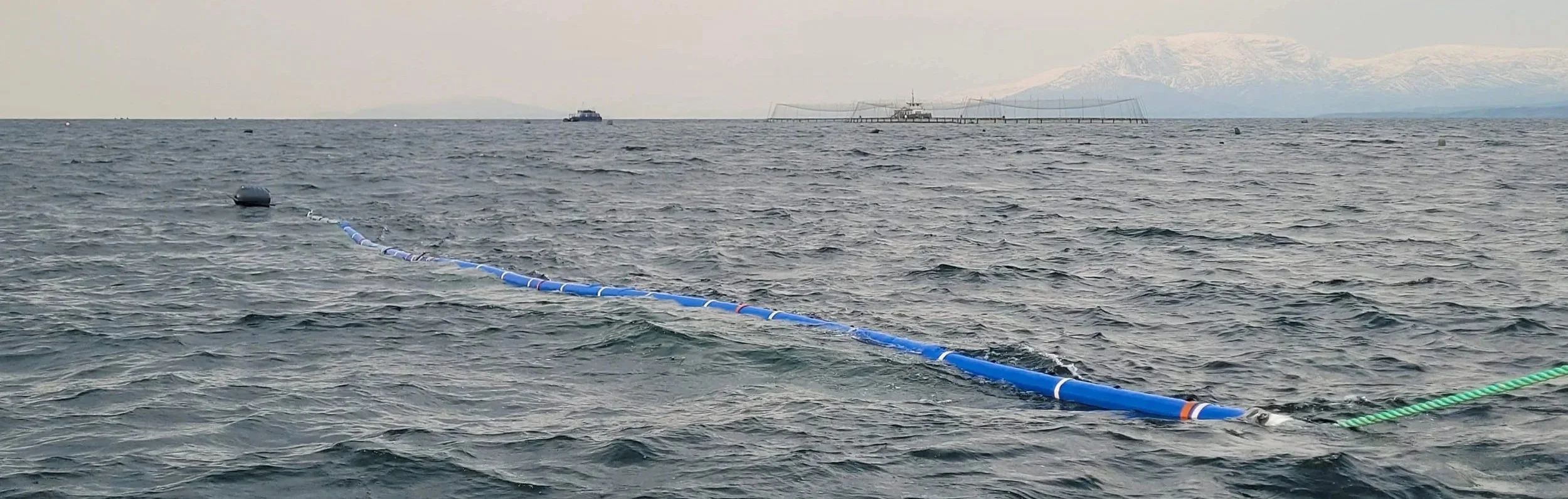
SeaStrut pressure adaptive tube on test at Bantry Bay, Ireland as part of ULTFARMS
So can a tube really be that important?
In a time when people think of technology as AI, data centres and highly disruptive information technology changes, Impact-9’s latest decision to boldly come to market with a new tube may at first seem a little – well – underwhelming. But read on to see why there might still be a few sparks of “big tech” left for those of us still practicing more mechanical disciplines.
Tubes are already everywhere in aquaculture. Fish pens for the global salmon and marine finfish industries generally use floating collars formed by HDPE plastic tubes that have proven durable and provide the right balance of flexibility and resilience for suspending nets. Increasingly, such tubes are also being used in marine shellfish production systems to replace ropes and floats with more engineered approaches to spreading cultivation substrates in the sea.
But recently Impact-9 has been focusing on a new structural approach: the integration of modular pressure adaptive cultivation tubes, called SeaStrut, which have shown promising results on recent farm trials as an enabler scalable Aquaculture. Impact-9 are positioning themselves to be the engineering integration layer that converts SeaStrut into better farms.
Starting with seaweed
Impact-9 CEO and inventor John Fitzgerald explains:
"While I believe SeaStrut has applications across aquaculture and beyond, our recent focus on seaweed cultivation has presented us with a really powerful innovation test ground. The biomass is light and the risks are manageable, so we can build and iterate solutions quickly on live farms alongside operators. There is also pent-up demand for a real breakthrough in cultivation productivity so that producers can realise the myriad of seaweed valorisation pathways that require abundant and affordable biomass."
This is a globally important challenge. Today, more than 38 million tonnes of cultivated seaweed are produced annually worldwide, supplying food ingredients, animal feed additives, bio-stimulants, nutraceuticals, cosmetics, biomaterials, pharmaceuticals, methane-reducing livestock supplements, bioplastics and emerging biofuel applications. Yet the overwhelming majority of this production occurs in Asia, concentrated in countries such as China, Indonesia and the Republic of Korea. These regions benefit from established supply chains, large workforces and decades of operational learning. More importantly, many cultivation systems evolved around abundant labour rather than abundant automation.
Europe has no shortage of sea. It has a shortage of low-cost labour.
Any cultivation system that depends on large numbers of manual interventions will struggle to compete against established Asian supply chains. The challenge is therefore not simply biological production. It is engineering productivity into cultivation systems.
Cultivating competitively priced biomass in Europe will require a step change in mechanisation, automation and offshore scalability. Only then can seaweed move from today's relatively niche cultivation sector towards something more analogous to mainstream agricultural production.
“To say we are replacing floats with inflatable tubes misses the point”
In his recent Financial Times article “How much value is AI really creating?”, Jon Burn Murdoch notes for technology in general “real jumps in productivity came from new companies and processes rather than incumbents grafting new technology on to existing workflows. In the case of electricity in the late 19th and early 20th century, productivity gains were modest where factories simply replaced giant steam engines with giant electric motors but left the rest of the machinery and layout unchanged. The boom arrived decades later when engineers fitted individual workstations with their own small motors”. Steam-era factories typically relied upon enormous central engines continuously turning mechanical transmission shafts running through entire buildings. Electric motors arrived. The obvious solution? Remove steam engine. Insert electric motor. Problem solved. Except it wasn’t.
Simply replacing the engine changes surprisingly little. The real productivity gains only arrived later, when factory designers realised something much more important: Electric motors did not simply replace steam engines. They eliminated the constraints that created steam-era factories in the first place. Marine Aquaculture Farms may be facing a similar moment, if they are to expand beyond bays and realise their true potential.
Fitzgerald emphasises, “It is for this reason that Impact-9 is not trying to sell tubes. We are positioning ourselves as the integration layer that converts pressure-adaptive structures into better farms. And to do that in close partnership with our farming customers.”

Re-thinking low trophic farming
Creating economically competitive production of low trophic species like seaweed and shellfish in higher-cost regions such as Europe requires something different. Labour productivity matters. Operational reliability matters. Scalability matters.
While many seaweed farms rely on arrays of individual longlines operated from local harbours, the need for denser area utilisation and expansion into more energetic offshore zones means alternative farm architectures become increasingly attractive.
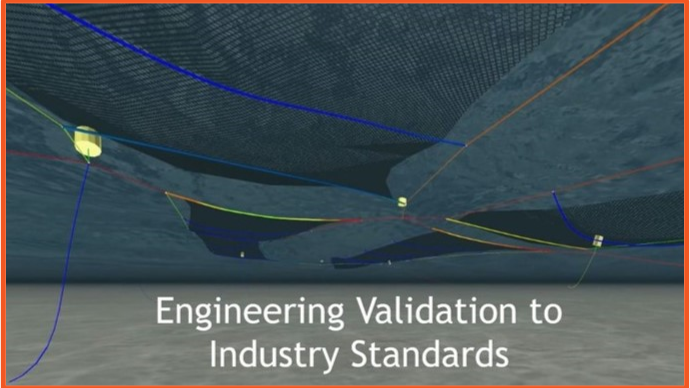
Impact-9 began exploring alternative approaches with partners in the Horizon Europe ULTFARMS consortium, leading to iterative testing and engineering analysis of submersible hardware for seaweed and mussel farms. More recently, supported by Ireland’s Marine Institute and seafood development age ncy BIM, Impact-9 has recently completed a feasibility assessment and Front End Engineering Design (FEED) work for a Submersible Seaweed Grid (SSG) architecture for nascent seaweed producer Sea & Believe to cultivate Palmaria palmata (Dulse) in Ireland. The work includes sea trials at Cleggan Bay, site-specific FEED, numerical modelling and techno-economic assessment of future commercial deployment.
The opportunity emerging is not merely submergence of farms. It is enabling farm architectures that simply work much better. "SeaStrut is not a better float. It is a different design constraint", claims Fitzgerald. The interesting thing about changing the design constraint is that a surprising number of second-order effects begin to emerge. Taken together, Impact-9 is confident of enabling farmers to produce over 2,500 tonnes of fresh weight biomass per square kilometer per year, while getting production to €600 per tonne, even for attainable 1000 tonne (40 hectare) production units. This presents opportunities to expand operations at existing coastal seaweed farms, as well as moves further offshore or for the co-use of offshore wind zones as promoted by Ultfarms.
Resilient Structure with Reduced Materials
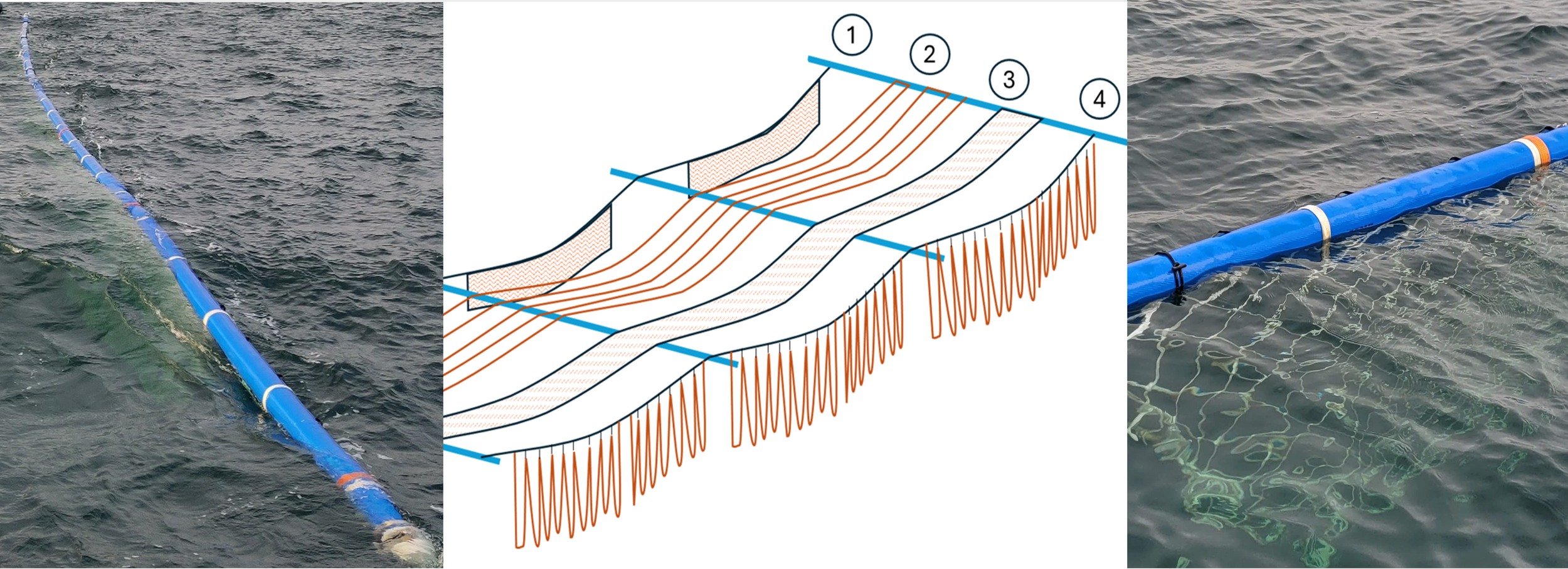
SeaStrut SW-6 deployed to spread kelp substrates at Bantry Bay Ireland for ULTFARMS. The modular tubes can be configured with a variety of seaweed and shellfish substrates depending on biomass weight, etc.
The tubes do not simply replace floats. They can simultaneously replace floats, spreader bars, buoyancy modules and other structural elements while introducing new functionality.
Because these pressure-supported structures derive strength primarily from internal pressure rather than structural mass, they offer a unique combination of flexibility and load carrying capability, for less material input – a crucial equation to underpin the sustainability credentials of such cultivation.
They bend in waves to alleviate loads. They can vary their properties through pressure changes. They exhibit graceful overload behaviour, collapsing temporarily to avert the worst effects of any extreme loading before returning to their original form once loads reduce.
Highly Productive, scalable operations
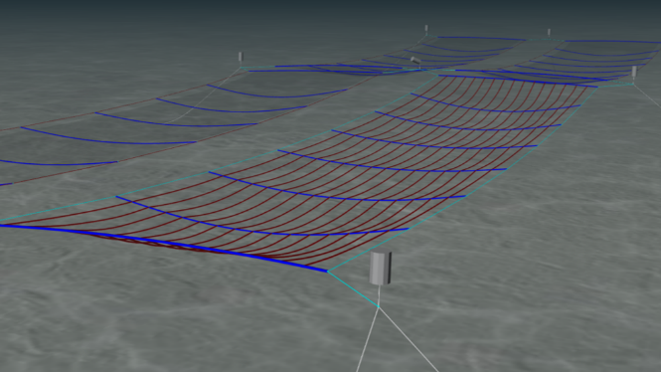
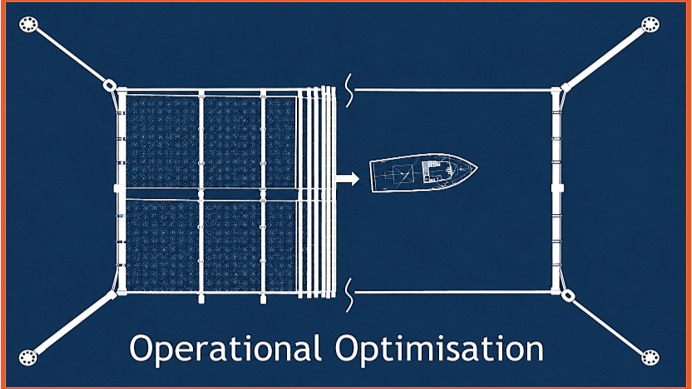
Numerical Model of 4 Submersible “Rigs” developed by Impact-9 for Palmaria production, in a 2×2 mooring grid
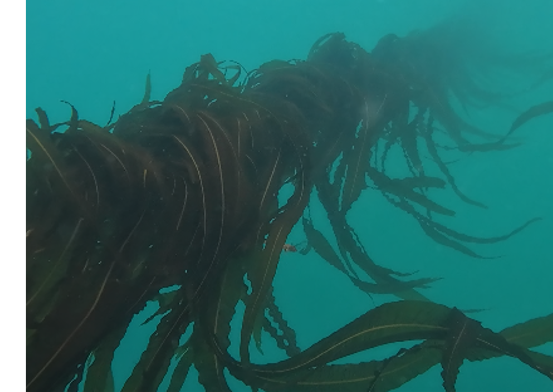
Saccharina Latissima growing on a rope at Bantry, Ireland. Impact-9 envisaged in-situ “combine harvesting” of biomass on parallel ropes by a towed harvester connected to an overhead vessel.
So SeaStrut tubes are an ideal way to maintain separation between adjacent cultivation substrates in dynamic conditions, allowing denser deployment and improved utilisation of licensed sea area. But that is not enough on its own: more important is how they facilitate operational efficiency and industrial scaling.
The pressurised tubular geometry offers a unique opportunity for “quick connector” solutions that allow substrates be snapped onto the grid and slid into any desired position while in a low pressure (buoyant) condition, unfurling seeded substrates like a curtain. Once at operating pressure, attachments are then secured in position to such an extent that abrasion mechanisms are eliminated, prolonging the useful life of materials at key wear points.
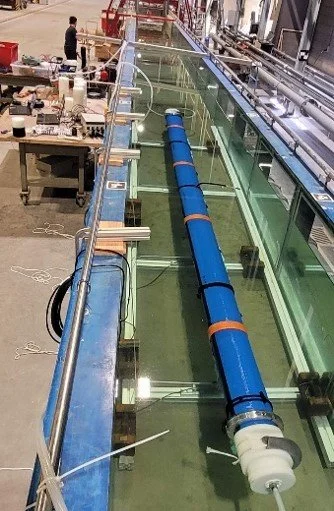
These inherent features allow the rapid build-up of “rigs” with seeded substrate in the field. However, Fitzgerald doesn’t think it stops there: “We found these tubes lend themselves extremely well to towing operations – behind relatively small boats”. At scale, it is envisaged that large “rigs” with many kilometres of seeded substrate can be pre-prepared in harbour, optionally to be deployed partially collapsed for an initial establishment growth phase. They can then be towed offshore, unfurled and attached to the mooring grid in a single unit. This means that vast quantity of substrate can be installed offshore by relatively small vessels shuttling from a small harbour.
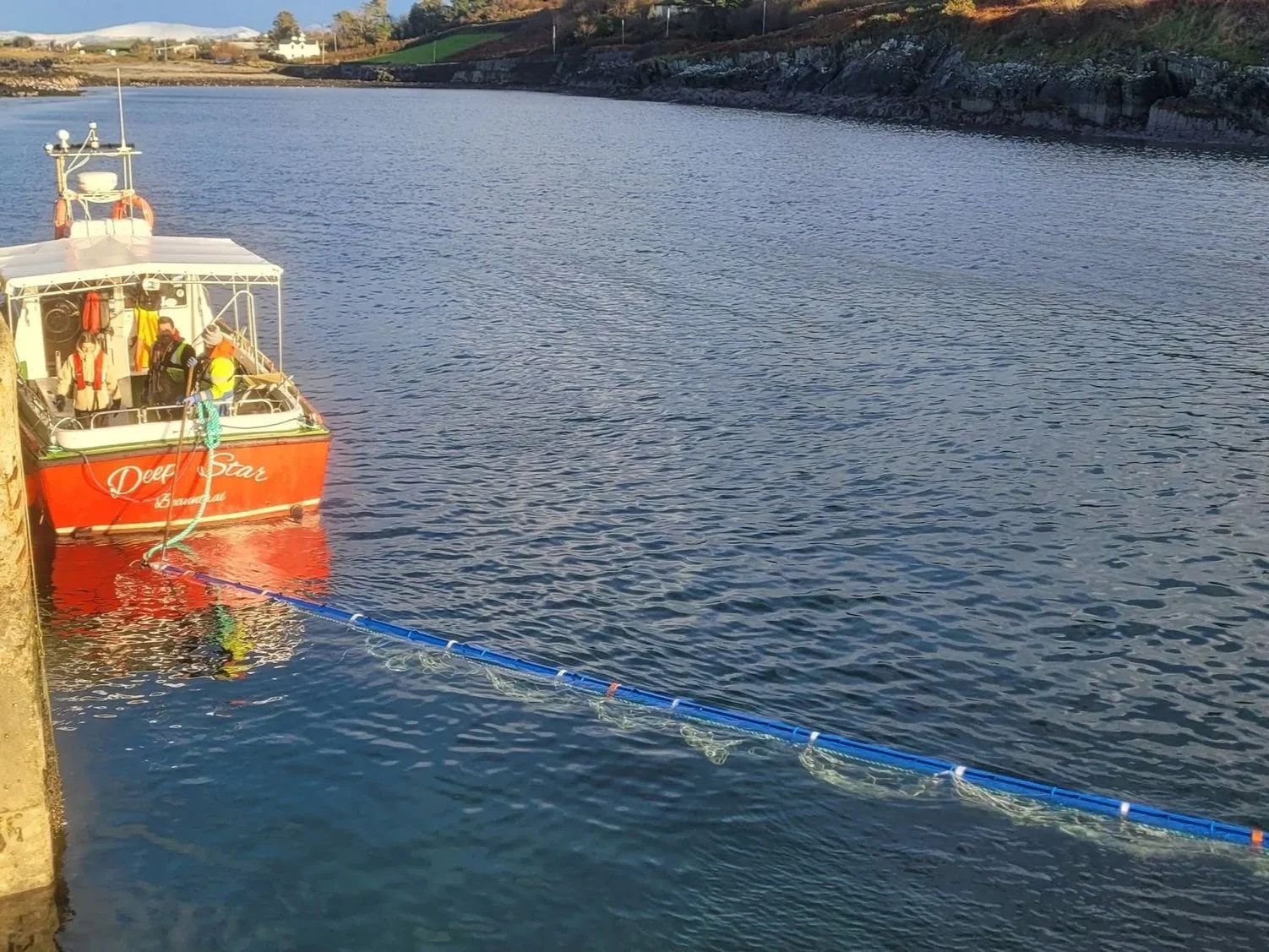
Towing trials of a single 30m long SeaStrut tube with seeded substrates integrated. At scale a Rig of 8 such tubes and up to 2km of seeded kelp rope can be towed as a collapsed unit to be unfurled offshore.
Harvesting Innovations
At harvest, the rig can be de-pressurised to float to the surface, substrates disconnected and stripped like a typical harvest work boat. However, Fitzgerald anticipates operations will ultimately exploit the submersible grids fully, submerging deeper at harvest to allow vessels to operate overhead and using bespoke harvest machinery to strip, de-water and convey crop directly from the in-situ substrate to adjacent transport barges, replicating combine harvest operations familiar from agriculture.
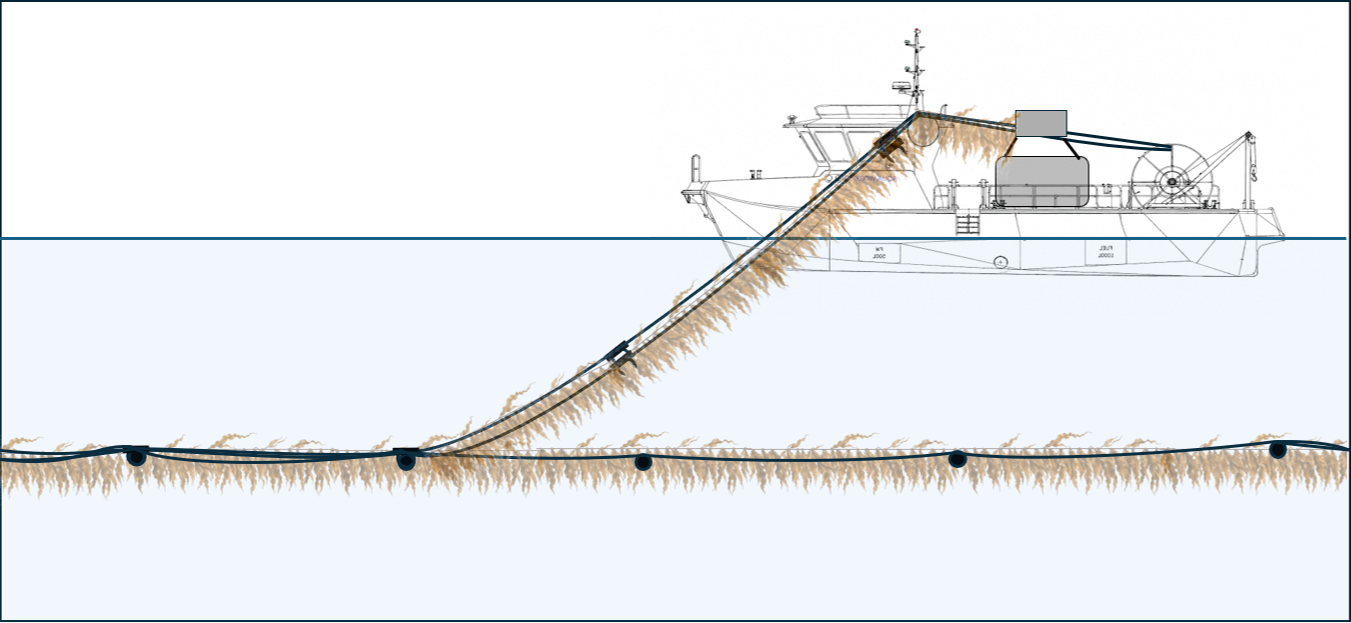
Over-water harvesting concept under development at Impact-9
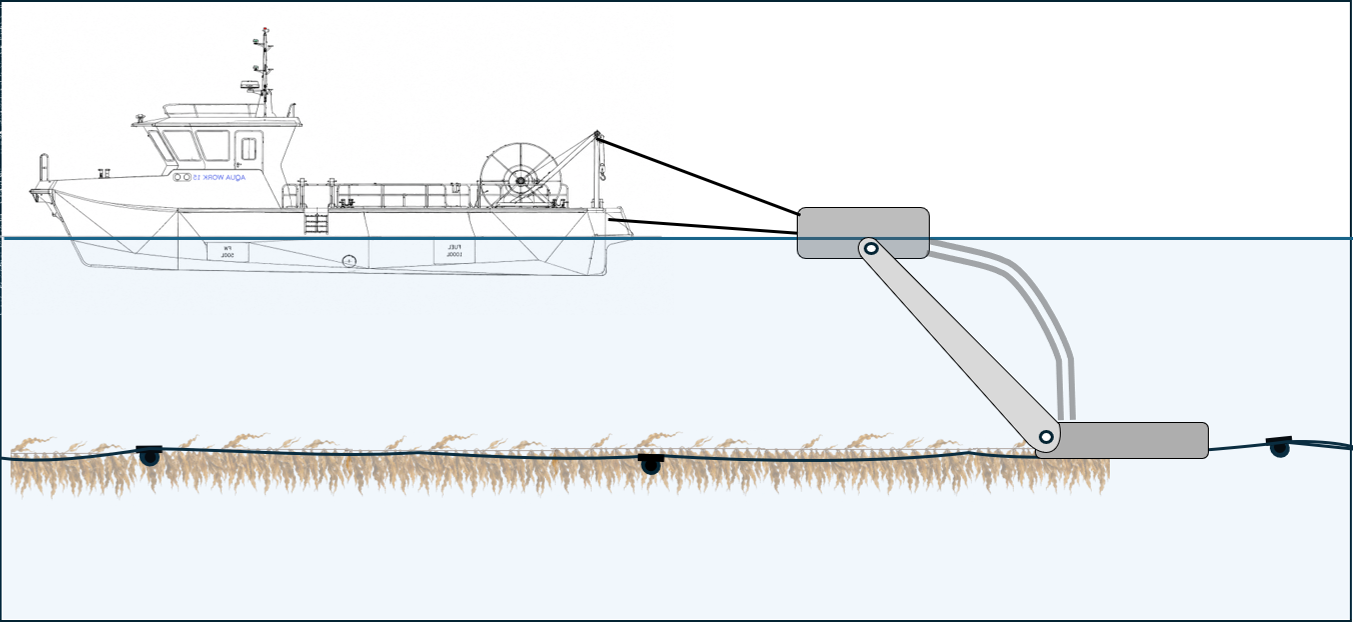
Under-water harvesting concept under development at Impact-9
Submersion Control: Simple, Stable, Proportional.
By simply connecting a seawater pump to a single umbilical, an entire “rig” can be submerged to a desired operating condition at installation. Because of the patented pressure-activated ballast control (learn more about that here), ballast stability is maintained throughout the system.
During grow-out, operators generally need to add buoyancy as biomass accumulates. This often needs in-situ monitoring and site visits to manually add floats to lines. However, for SeaStrut it couldn’t be simpler:
“When we need energy to autonomously move ballast, we find it is already there”
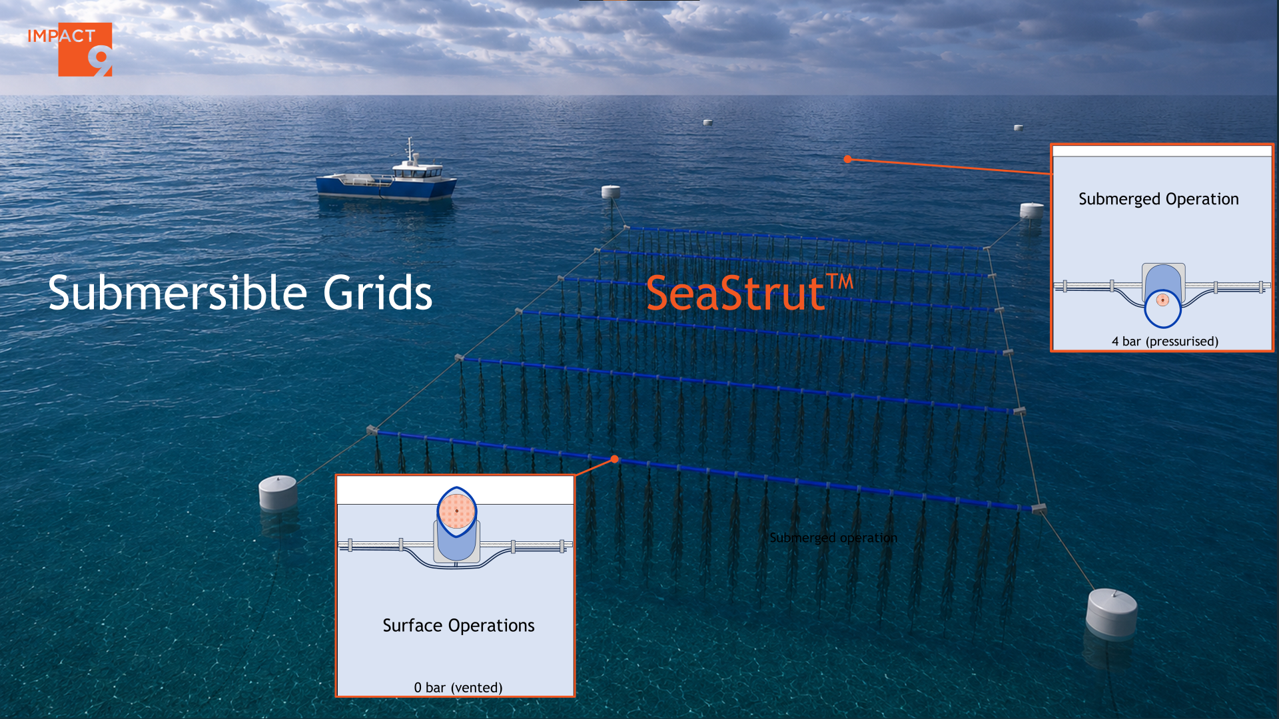
Due to the addition of energy through pumping seawater at the point of installation, there is stored energy already in the compressed gas within the system. Any leak results in slowly increasing buoyancy - a tendency to float, not sink, in response to unintended faults.
Crucially for operations, the tube will simply expel ballast once a valve is opened: something that can be triggered passively (a float actuated valve) to prevent excessive submergence, for example. Operators may also choose to actively adjust ballast to optimise growing conditions. For example: in response to light intensity, surface water temperatures or the presence of invasive species. This enables a precision farming approach that can then be operated from a centralised, shore-based, remote monitoring station and Impact-9 is working with partners on the integration of sensors and telemetry to allow this.
Autonomous Wave-Activated storm submersion
The need to visit a site at all then only arises if there is a need to re-pressurise the system (to submerge deeper), using a seawater pump on a work boat. This might be a requirement in advance of storms, in order to protect stock from the worst effects of waves. “I still wasn’t really that happy with that”, recalls Fitzgerald. “The design focus was on removing the need for any offshore operation we possibly can, and now I need to time an intervention in advance of a storm”. However, with SeaStrut and perhaps inspired by his previous work on wave energy, the inventive solution to integrate wave-activated pumps on grid corner floats means that high pressure water can be made available to top up pressure to an operating set point, and also submerge the system in response to excess storm energy - all without operator intervention. This novel solution allows for reliable self-regulation of submergence depth during stormy periods, with no operator intervention whatsoever. “I knew it may take us a little time to iron out some niggles there, but it was at that point I knew that we had finally hit on an architecture that can actually deliver the economic leap in operational costs, required for low-trophic aquaculture to scale – and it all stems from those pressure-adaptive tubes”
Greatly Reduced Visual Profile
A final barrier to scaled operations can often be social acceptance. While low trophic aquaculture boasts strong societal credentials, any effort to “industrialise” coastal zones can still meet resistance. Arrays of grid flotation are not always a welcome sight. However, with SeaStrut, surface buoyancy is reduced to just grid corner floats, so the visual profile of the system is vastly reduced. Even when surfaced, the slender tubes offer very little visual intrusion and the ability to control ballast and compensate automatically for biomass gains means that redundant float volume above the surface is generally not required. Spare buoyancy is stored in the compressed “gas cells” within the SeaStrut tubes themselves, expanded only when needed. This can greatly aid planning constraints and public acceptance of developments.
Re-thinking fish farming structures
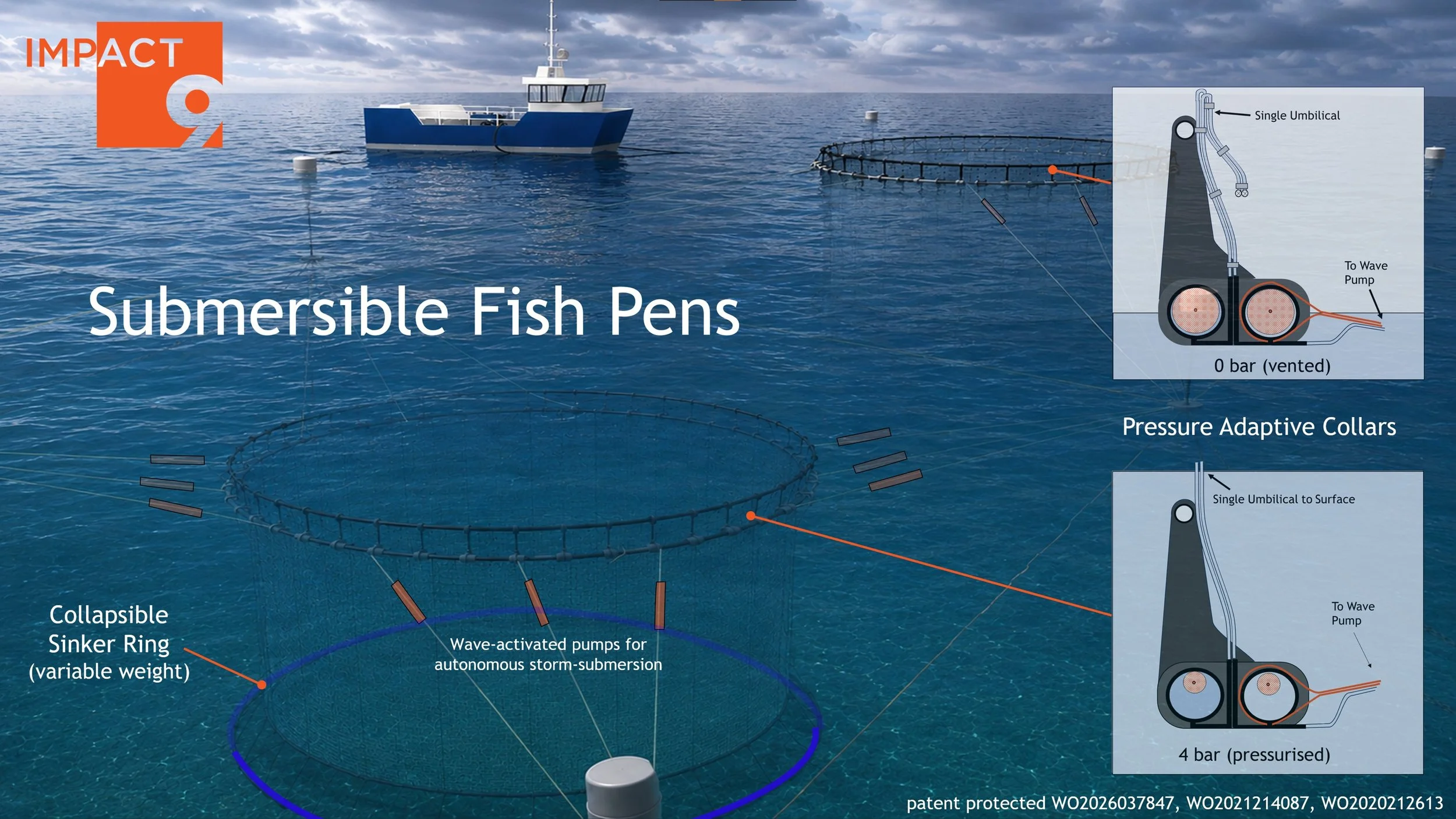
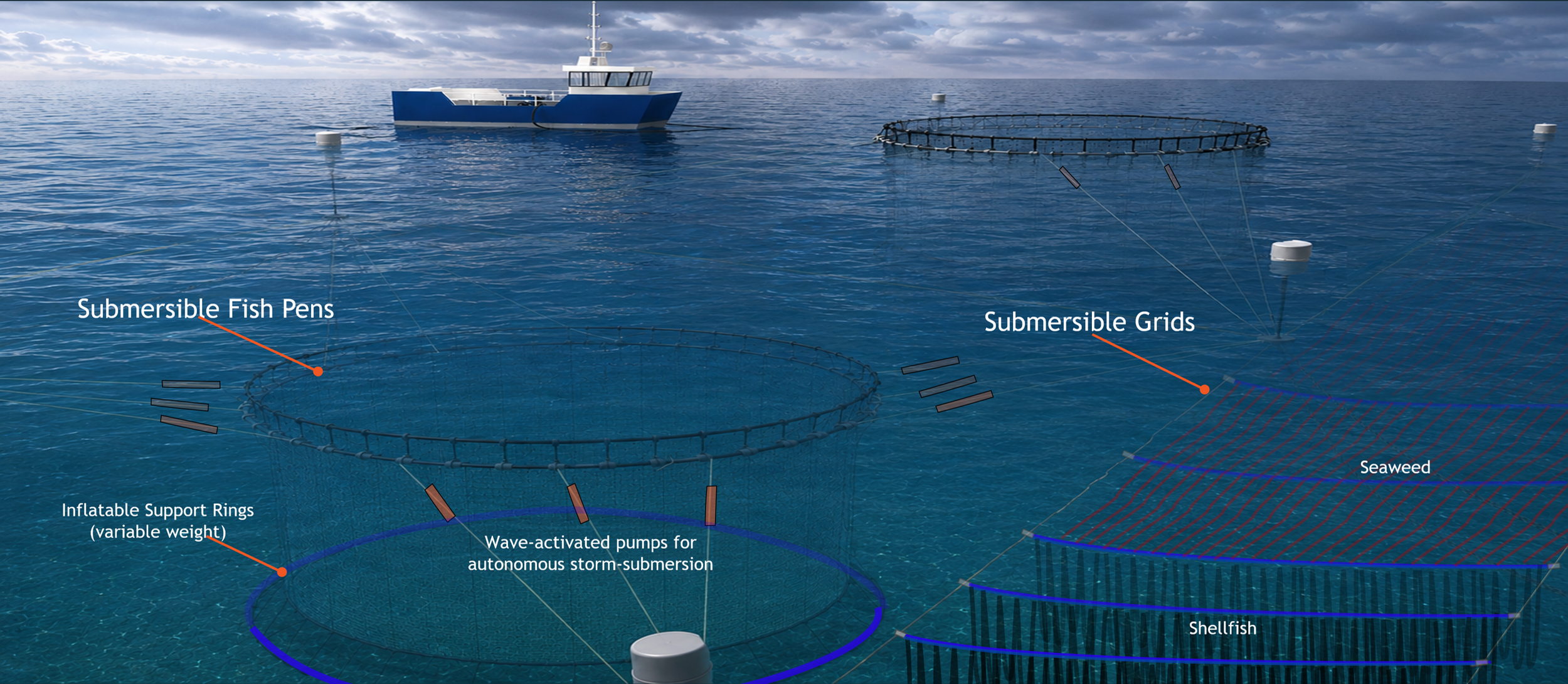
The same principles can be adapted to existing fish farming pen designs in the near term.
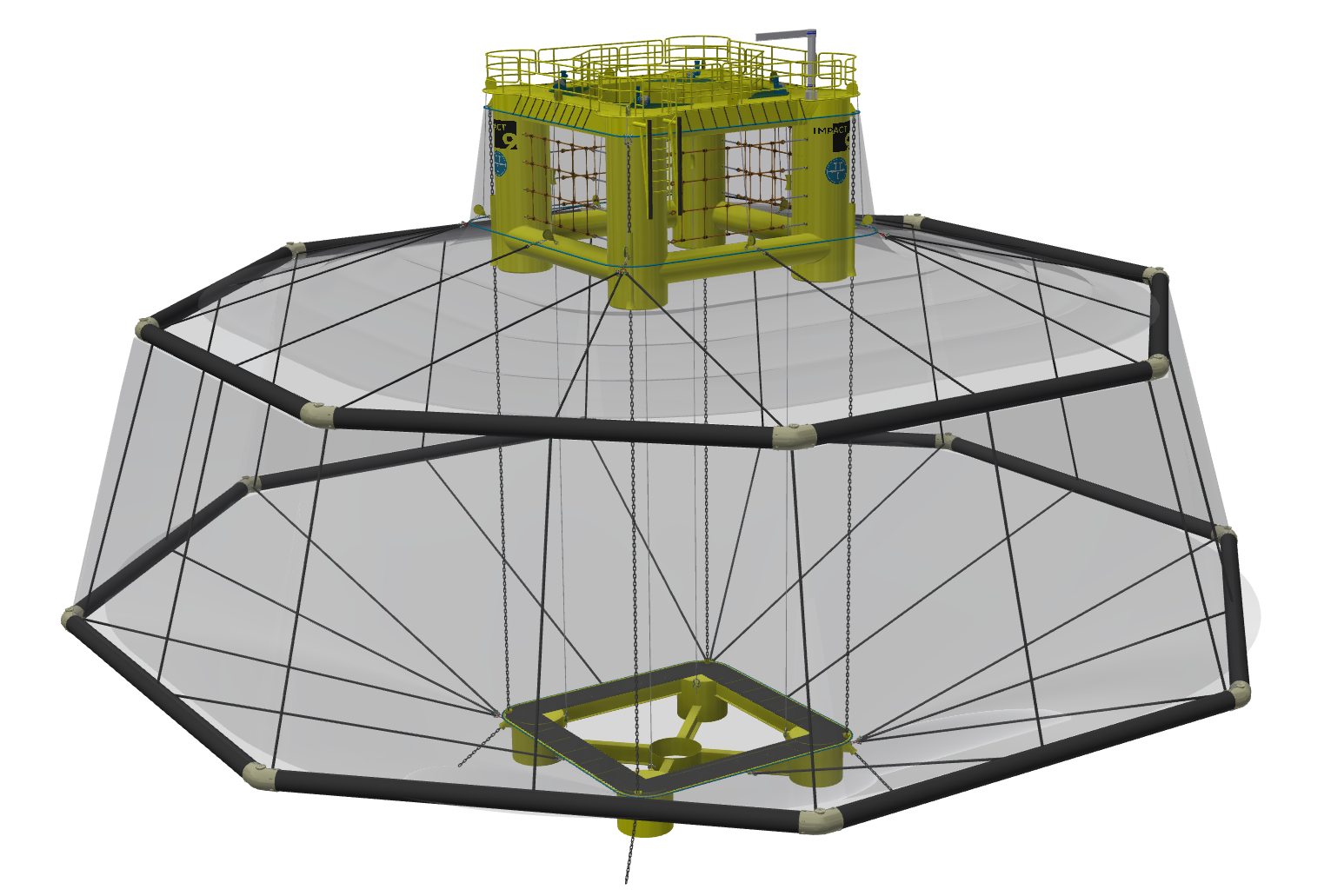
Once proven, the technology is likely to lead to more novel offshore pen architectures such as Net9, the system for which SeaStrut was originally developed.
If the above list of features seems highly specific to low trophic farming, it is worth noting where the idea for pressure-adaptive tubes originated.
The original concept emerged during development of Impact-9’s Net9 open-ocean fish farming concept. Without a conventional floating collar, the design required fine control of ballast within net-supporting structures. That ballast also had to remain exceptionally stable, eliminating roll and pitch effects, caused by fluid movement. This was the problem for which the pressure-adaptive tube was invented. Indeed, many of the problems encountered in aquaculture in general are ultimately ballast and stability problems, disguised as structural problems. While low trophic farming now provides the most practical demonstration pathway, Impact-9 sees fish farming applications following directly from those learnings.
"Perhaps Net9 is a little too imaginative for today's market maturity. Maybe we do first need to replace the steam engine with an electric motor just to show it works!" Fitzgerald quips. "But once operators see autonomous storm submergence, distributed buoyancy control and pressure-supported net structures operating in the real world, I suspect they will start asking much bigger questions."
Foreseeable fish production applications include:
• Improved storm submergence systems
• Inflatable sinker rings and alternative barrier support structures
• Distributed buoyancy control for submerged barriers
• Wave-activated autonomous operation
• Future offshore containment concepts like Net9 and beyond
People occasionally ask whether Impact-9 has pivoted away from Net9. The reality is almost the opposite. Net9 forced us to identify what actually matters. We may have pivoted early demonstration from fish production, to low-trophic production. But this is because the enabling technology underpins a much broader range of opportunities than first envisaged.
The immediate objective is not open-ocean aquaculture. The immediate objective is proving the building blocks. Deploying them. Learning from them. Demonstrating value in seaweed farms, shellfish systems and conventional fish farming infrastructure. Because if those building blocks prove themselves in today's farms, tomorrow's offshore systems become considerably less radical.
#Aquaculture #Seaweed #FishFarming #OffshoreEngineering #Innovation #BlueEconomy #OffshoreAquaculture