
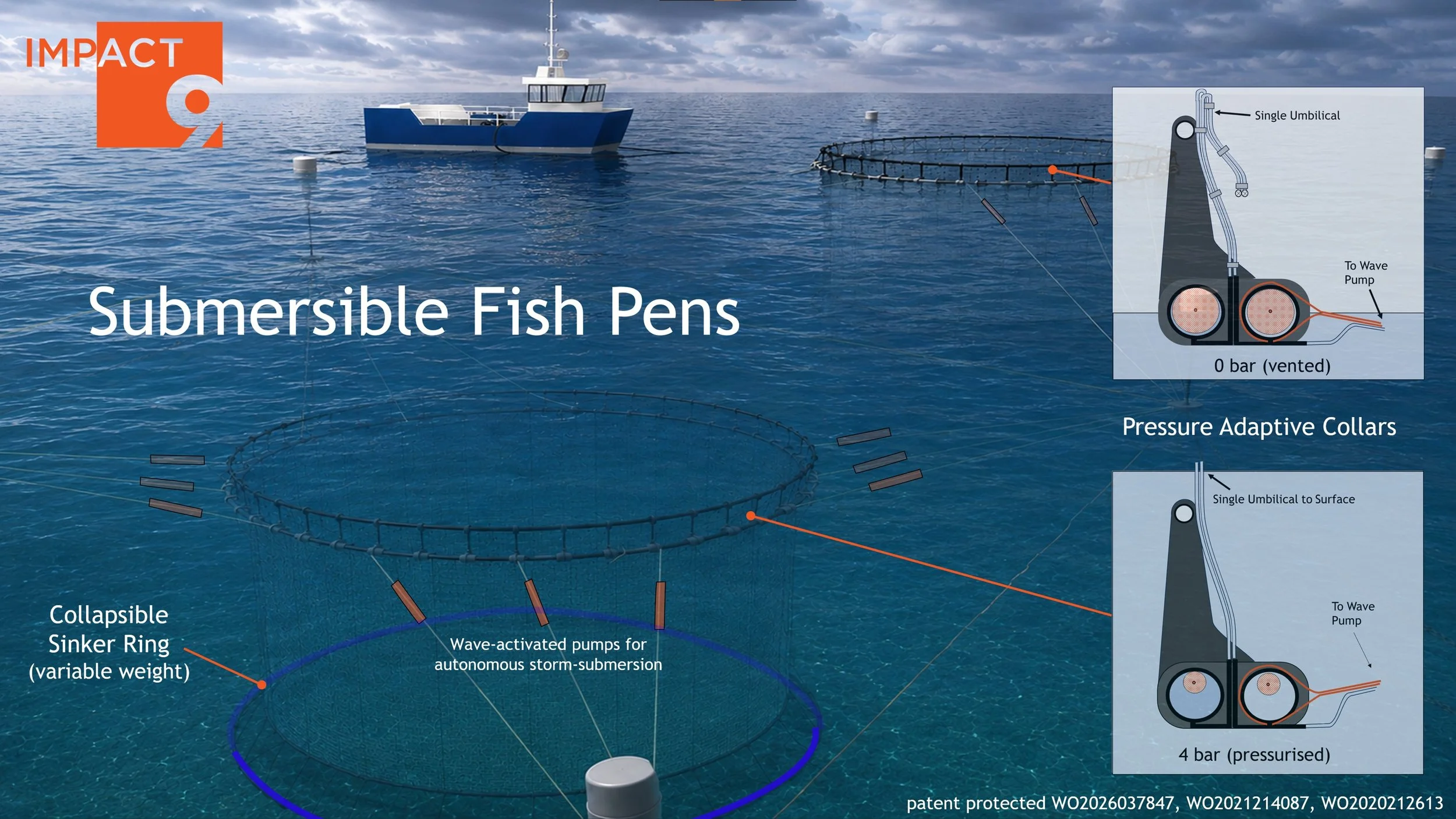
Impact-9’s technology can be readily adapted to conventional fish pen designs to affect submersion control and improved structural resilience. This is becoming increasingly important to protect stock from sea lice, parasites or warmer surface water as well as from storm waves at more exposed sites. Improvements include:
-
Impact-9’s pressure adaptive collars require only a single seawater pump to affect stable submersion. Internal buoyancy is provided by special gas cells that compress under pressure of introduced sea water. As these cells are secured in position, a proportional, stable and equal buoyancy control around the full perimeter of the collar, requires just a single water pressure umbilical. As water is the control fluid, there is fine control over the amount of ballast introduced to the collar and the system is isolated from any de-stabilising effects of external ambient pressure as depth varies.
-
The pressure-adaptive submersion allows for the integration of wave-activated pumps in the mooring connections, that pump high pressure water in response to dynamic mooring loads. When this in-flow exceeds a threshold it will cause the system to submerge autonomously, reducing the mooring loads. This self-regulating response protects the structure and contained stock from excessive dynamic loading in storms, without requiring any on-site intervention by the operator.
-
“Sinker Rings” are now used ubiquitously in fish pen design to improve the volumetric stability of the net barrier system in response to current flows and waves. These are normally formed by rigid HDPE pipe with steel weight inside, suspended from the floating collar with winched cables. By replacing the HDPE pipe with inflatable SeaStrut elements, we can provide a variable weight sinker ring that can also be depressurised to its most buoyant condition and collapsed for easier handling. By integrating numerous such elements in net barrier design, it is possible to stabilise the net geometry and tune its weight in response to simple application of water pressure. Going beyond retro-fitting for traditional “sinker-rings”, this provides opportunities for entirely novel approaches to supporting immersed net-barrier structures, especially to support new open ocean containment solutions such as our Net9 concept.
-
The design approach increases fish farm resilience in a number of subtle but important ways:
passive submergence response to storms with regulation and damping of mooring attachment loads
The use of high pressure to achieve the submergence state means that in a leakage event, the system fails to a positively buoyant condition.
The pressure-supported tube structures remove the risk of collapse under ambient pressure at depth, without needing to thicken pipe walls.
Collapsible SeaStrut elements are more flexible in dynamic conditions, reducing dynamic snatch loading. They also exhibit a safe overload response, whereby they return to their original form when any excess load is removed.
SeaStrut: A leap to Inflatable Net Support Structures?
Fish pen nets are now invariably suspended from HDPE pipe “collars”, connected to compliant mooring grids. These have proven to be more durable compared to older steel pen structures, flexing under moderate exposure to wind-driven waves, while standing up to currents. Inflatable structures are a logical evolution. The prospect of operating farms in increasingly exposed conditions presents significant challenges to providing cost-effective support structures. The integration of SeaStrut reinforcement elements within net barrier design presents opportunities for highly resilient, scalable structures with less material cost. SeaStrut elements of controllable weight/buoyancy present an entirely novel pathway to optimise future net barrier design for exposed and open ocean conditions. This is exemplified by our open ocean net barrier design concept.
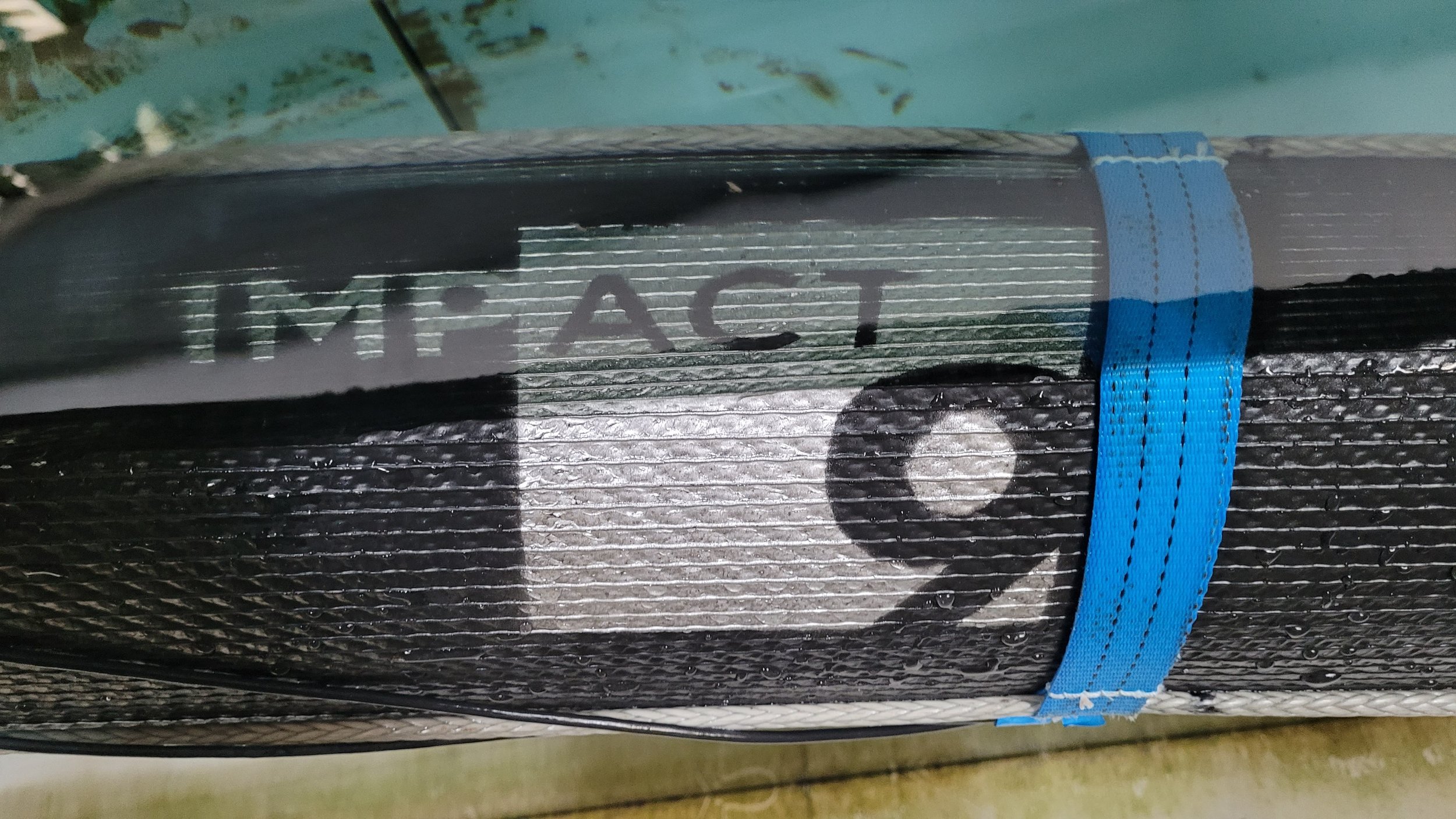
Collapsible Net Support Ring under test
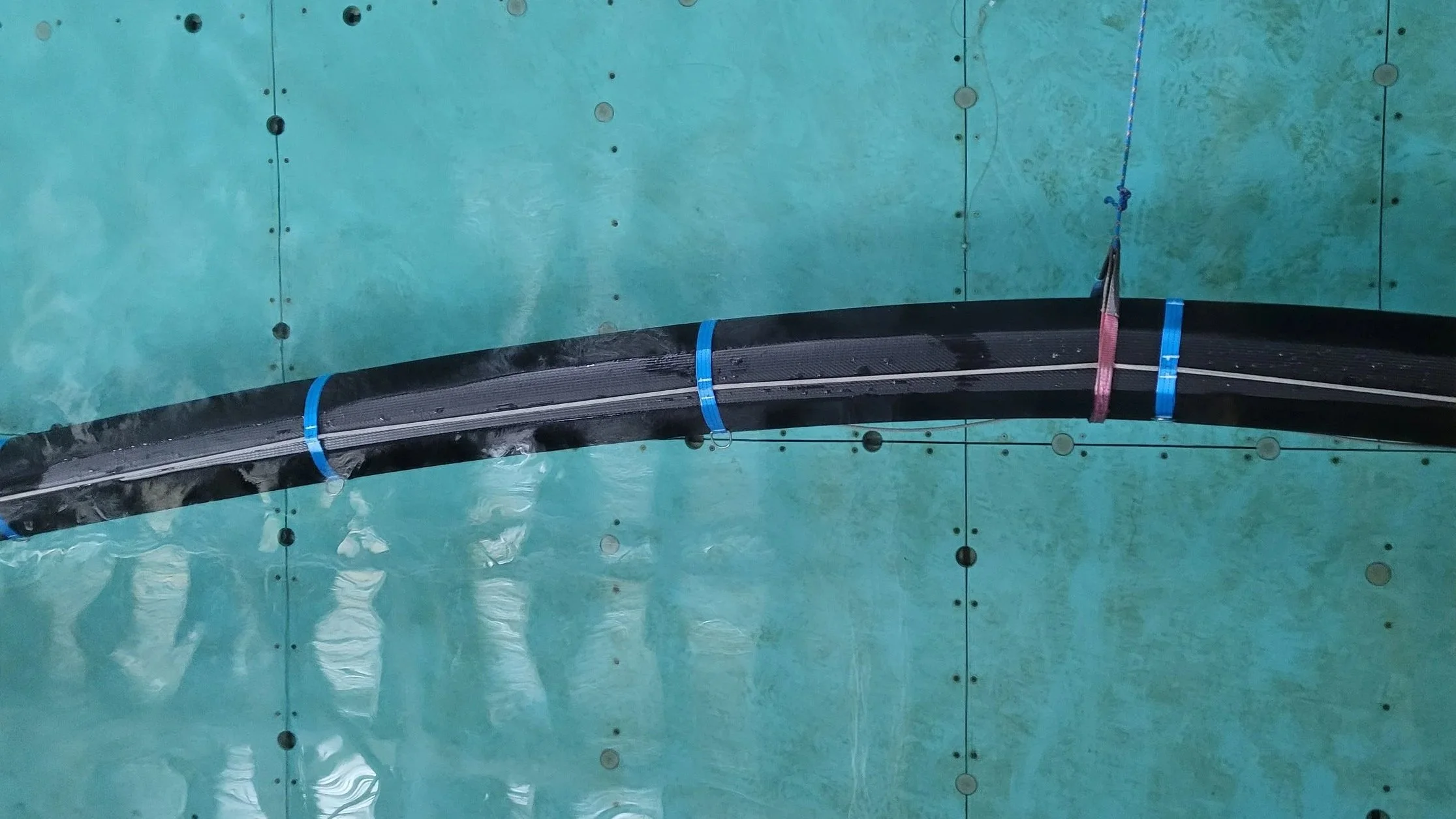
Collapsible Net Support Ring under bend load testing
Towards Open-Ocean Operations
Open ocean fish farming is in its infancy, with early endeavours turning to more traditional offshore semi-submersible steel structures to provide safe offshore platforms. These are designed to attenuate and resist wave-induced motions to support human-centric operations. However, when the ocean moves, fish move with it. This results in relative motions between the operating platform and the ocean. In aquaculture, this has consequences for fish health in storms. From the fish’s frame of reference, nets and structures will be accelerating through their habitat requiring them to swim against accelerating flows to avoid impacts. In open ocean aquaculture, where waves can reach heights of 35 m, providing a fish-friendly containment structure, physically integrated within a conventional steel operating platform requires a more innovative approach. Impact-9 has used SeaStrut integrated with patented elastic solutions to address new architectures to address challenge, exemplified by the Net9 fish pen.
Interested?
Impact-9 can help your project to implement these solutions in your marine project as well as undertake suitable engineering assessments to satisfy your project stakeholders. If you would like to learn more, check out the link below or, why not reach out and let us know a bit more about your needs?